
Guest Post by Heather Hohlowski
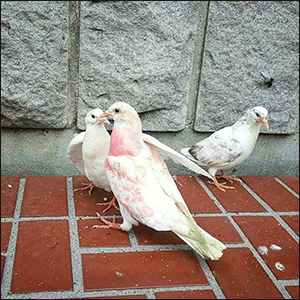
The Three Melons
Cantaloupe did — pigeons are fighters! Supportive care, including hand feeding soft foods, keeping the bird warm, and maintaining hydration are critical for birds with PPMV. Recovery, when it occurs, takes several weeks. Cantaloupe’s neck twist was fairly severe in the beginning, but it steady improved during his stay in his loving foster care home.
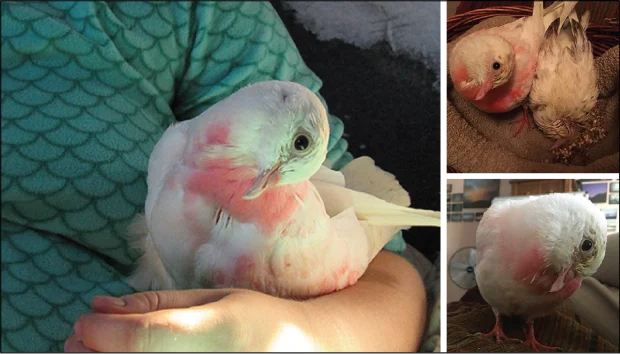
The torticollis steadily improved over time
The Origin of King Pigeons
King pigeons are “utility birds” — bred for meat (known in restaurants as “squab”, which is the term for young domestic pigeons, typically less than four weeks old). The breed was created in the 1890s by Harry Baker, a pigeon fancier (as well as an undertaker). Harry crossed four pigeon breeds to create the King: the white Mondain/Duchesse (a breed known for its grace), the white Racing Homer (known for being alert), the white Maltese (a compact breed), and the Runt (another so-called “utility bird” bred to have a large body mass).
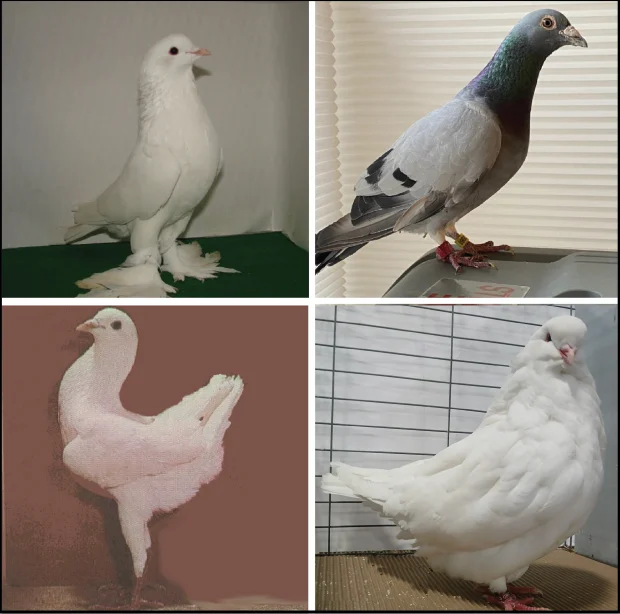
Clockwise from top left: Mondain/Duchesse (from www.pigeontype.info), Homer (by Palomacy), Giant Runt by John Verburg, Maltese (by John Verburg).
King pigeons are larger than most pigeon breeds and can weigh two pounds (570 grams) on average. Compare that with a Homer, which weights between 300 and 500 grams, or a Feral, which weights an average of 350 grams.
These birds are typically sold in live markets, including those in San Francisco. (We suspect that is where the Three Melons came from.) Often the baby birds are dyed bright eye-catching colors like pink or blue or purple. People walking through these markets are often shocked to see these birds being sold as food, so they buy them and release them, not knowing that this is almost always a death sentence.
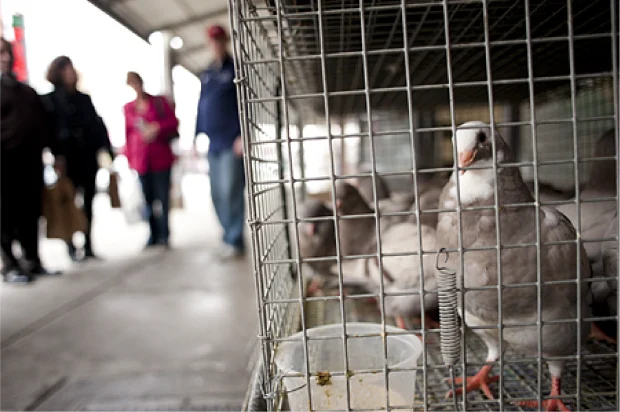
Shun Da live poultry market (now permanently closed), Philadelphia, PA, photographer unknown
Domestic birds cannot survive in the wild — not in parks, not in cities, not in the sky. They have no wild survival skills and when free will wander hopelessly, in desperate search of rescue. Many will be killed by birds of prey or cars; many die of starvation or dehydration.
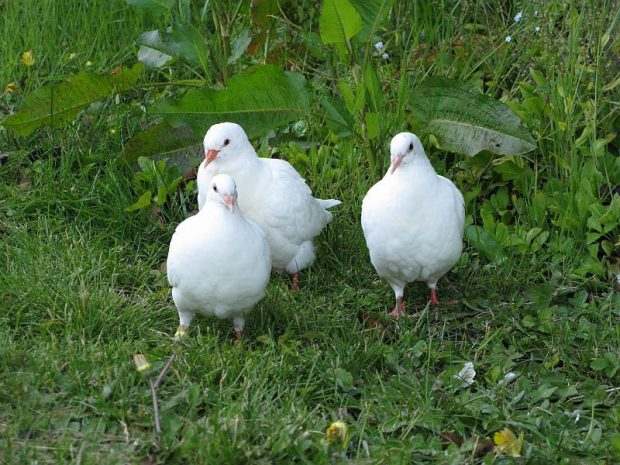
Duke, Dawn, and Pip, rescued in Golden Gate Park
Cantaloupe was in foster care for a little more than two years before we started fostering him. We had already started fostering Paige, another Palomacy rescue and a survivor of pigeon racing, and we wanted to find a friend for her. The two immediately hit it off, and we adopted both of them a couple of months later.
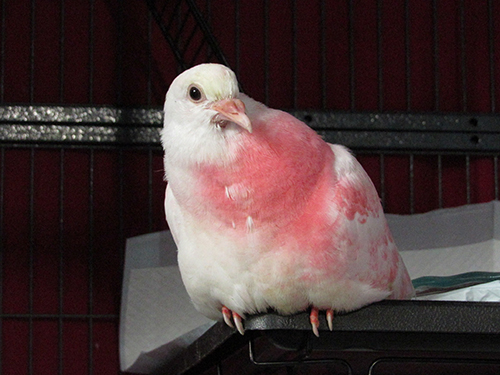
Cantaloupe was dyed pink by his breeder. Though in this photo his torticollis is showing improvement, the dye remained for quite some time.
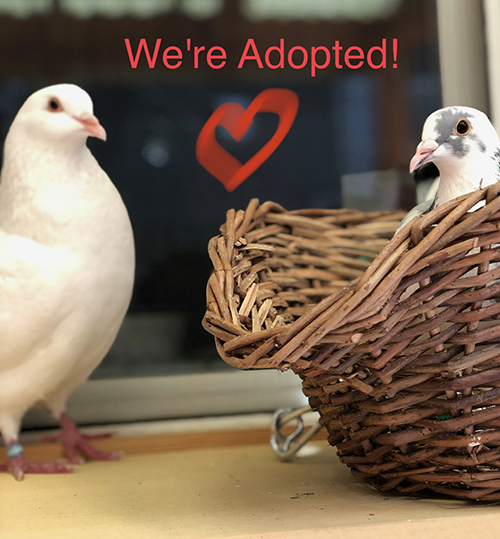
December 13, 2019
Cantaloupe is most definitely what you would call a character. He still has a slight twist in his neck, which makes him look like he’s curious about everything. And he IS curious. He’s also not a very graceful flyer (likely, in part, due to the torticollis) and he is quite lazy. So he will always take the ramp if one’s available. We have his aviary set up so that there are four ramps that spiral up to his nest box. His neck twist also makes it difficult for him to preen his feathers well, so we do a lot of that work for him. When we sit with him and help him scratch his pin feathers, he does his preening pantomime in sync with us (also called “air preening”). He LOVES this — we refer to it as taking Cantaloupe for a spa day.
Always ready to pose for the camera, Cantaloupe is a really fun subject to photograph. We have thousands of photos at this point — even though many look the same, we can’t seem to delete any because every single one is cute. See for yourself:
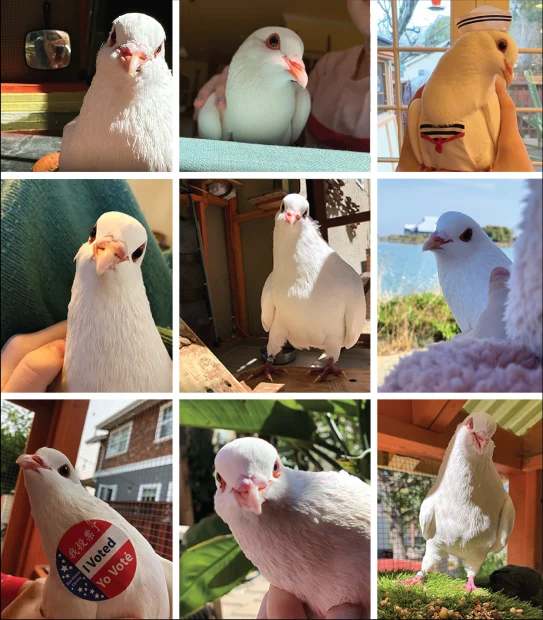
Could you delete any of these photos from your collection?!
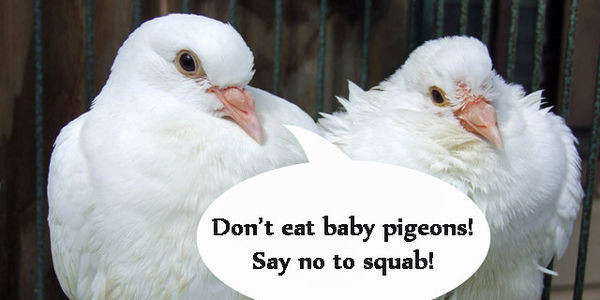
Like all animals, King pigeons deserve better than to be bred as “utility birds” and slaughtered at less than four weeks old to be served as squab in restaurants. Kings are gentle giants with sweet dispositions. They show affection, they love and protect their mates, and they adore head scritches. Let’s all sign the petition and say no to squab.
Say no to squab!
