

A good book shared with a good bird – everything is better with clean air!
Let’s talk about air purifiers!
Any pet can trigger allergies, and birds are no exception. Pigeons and doves can be dusty, and clean air is important — for you and your bird!
A lot of what you need to keep a pigeon or dove happy can be picked up at a thrift store, but when it comes to purchasing an air purifier, it’s easy to become overwhelmed by the number and variety of units on the market.
Fortunately, Palomacy moderator, volunteer, and Board member Rose Lalla Jensen has done the homework for you, and shares it here:
“Electronic” or ionizing air purifiers are widely marketed, but anything that uses ionizing technology or produces ozone is not safe. Ionization changes the magnetic charge of particles, making them attracted to things with opposite charge. In essence it makes them stick to those things much easier (eliminating the need for multiple layers of expensive, super fine filters). It also makes those particles stick to walls, furniture, and lungs — yours and your birds’.
Some air purifiers allow you to turn off the ionizing features. But performance ratings for those units are measured WITH the ionizers, and so it’s hard to know how effective they are without the ionization. That means it is impossible to compare apples to apples between units, or even determine which one you need, and no way to know if they are adequately cleaning the air. We recommend choosing one that does not offer ionizing technology at all.
“Mechanical” air purifiers, using medical grade or True HEPA filters, are safer. They filter out the smallest size particles without the use of ionization and without creating ozone. The purifier should say True HEPA or medical grade to be the real deal.
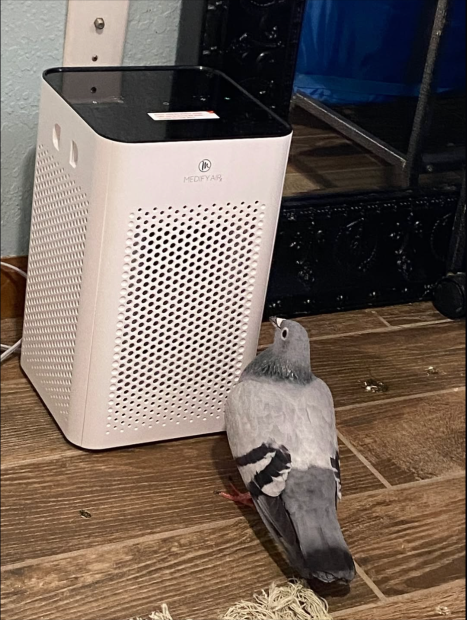
A new air purifier passes inspection! Photo by Ryan McLain
Once you have determined that the purifiers you are looking at are True HEPA/medical grade, you will determine which unit you need based on the size of your room.
You need to do a little math for that. The volume of your room is length x width x ceiling height. This is important, as purifiers all move different amounts of air during any period. You want the air to circulate a minimum of 3 times per hour, or more if you have severe allergies or a medical condition.
Take the volume of your room and multiply it by how many air changes in an hour. Then divide by 60. This gives you how many cubic feet per minute (CFM) the purifier needs to run. Compare this to the specifications on the air purifier. (If only one number is listed for the CFM, it is for the highest setting.)
Example: our family room is 14 feet wide and 48 feet long with 8 foot ceilings, and we need to change the air 3 times per hour minimum. So the math:
14′ wide x 48 x long x 8′ tall x 3 ÷ 60 = 268.8 CFM minimum. You can get more than one air purifier to reach the minimum. So for example, if a unit is rated for 150 CFM, two units would be needed for our room.
We have researched a lot of the most common manufacturers, and encourage you to do your own investigating. When in doubt, pass it up! And again, remember that if they have optional ionizing, the CFM and other specs are only true with the ionizing ON. Performance will be greatly reduced with it off. Many units are eligible for purchase with your Health Savings Account.
So here are a couple of VERY general recommendations for manufacturers:
Gold Standard:
Austin Air — These are costly, and the filters are costly, but they are popular with our rehabbers who share homes with many birds.
Budget-Friendly:
Levoit — most of their units are non-ionizing but check specs to be sure
or
Coway — again, check specs to avoid ionizing units
Honorable Mention:
The Airfanta 3pro is a reasonably priced mechanical unit.
There are many, many brands on the market, and it can become overwhelming. A handy tool is provided by the California Air Resources Board. This up-to-date, searchable database provides information on whether any given medel uses ionizing technology (electronic), or non-ionizing technology (mechanical). The website does not rate units for effectiveness, but focuses on reducing exposure to ozone. Use this website to search for manufacturers and model names and numbers to see if they are safe for use: https://ww2.arb.ca.gov/list-carb-certified-air-cleaning-devices

Enjoying the breeze! Photo by Meredith Saunders-Mattingly
