
By Nicole Borman — the Hearst Journalism Foundation
Dennys Balestra asks guests to take their shoes off before walking into her apartment. Most would expect to step into a sterile environment, with a shine on every service. Immediately, they are met with a chorus of “coos.”
Inside her 45th Avenue apartment live four pigeons: Higgins, Cookie, Dearheart and Revali. Revali is a homing pigeon, while the others are rock doves. Each bird has a distinct personality. Higgins craves attention and loves being social. Cookie is shy and prefers the comfort of her cage. Revali spends his days loafing proudly on high platforms beside his mate, Dearheart, who is strong-willed and fiercely devoted to nesting.
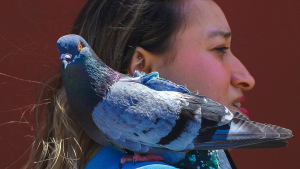
Balestra steps out for a breath of fresh air with Higgins by her side. He’s not used to traveling without his wife, Cookie, so he stays close to Balestra’s side for comfort. (Nicole Borman/ Hearst Journalism Awards Championship)
Balestra has loved pigeons for as long as she can remember. Years before adopting her birds, she even got a pigeon tattoo. As a child, she cared for 16 parakeets. Now, at 25 and working as a nurse practitioner, she considers her pigeons another kind of patient.
“I don’t want to just give them a place to stay, I want to give them a place to live,” Balestra said. “A place to kind of just be themselves and do as much as they possibly can.”
Because domesticated pigeons cannot survive in the wild, Balestra constantly refreshes their environment to keep them stimulated. Her apartment is filled with repurposed pet supplies: cat towers, dog crates, ladders and hanging bells. To let the birds fly freely indoors, she outfits them with “pigeon pants,” small fabric diapers that prevent droppings from spreading around the apartment. For sunlight and outdoor enrichment, Balestra straps their travel crates onto a cat stroller and walks them through the neighborhood. When she takes them outside individually, the pigeon pants can be fitted with tiny leashes, allowing the birds to stretch their wings safely.
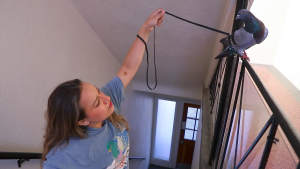
Balestra and Higgins decide whether or not to go outside. After much debate, Higgins agreed to get some sun. (Nicole Borman/ Hearst Journalism Awards Championship)
None of Balestra’s birds were rescued randomly off the street. Each has a reason they cannot survive independently. Higgins and Cookie were former pets and are fully domesticated. Dearheart suffered a broken wing and can no longer fly. Revali was once used as a racing pigeon.
Balestra adopted all four through Palomacy, a foster-based pigeon rescue in Alameda, California. Because many animal shelters do not accept pigeons, fostering helps relieve overcrowding at specialized rescues. Before approving adoptions, Palomacy requires birds to spend time in foster homes to ensure a good fit.
“Pigeons are very much all about home,” Cynthia Bardouka-Large said, Palomacy’s Co-Director.
Originally, Higgins and Cookie were only supposed to stay temporarily. After three months together, Balestra couldn’t imagine giving them back. In rescue communities, situations like hers are jokingly called a “foster failure,” when temporary care quickly becomes permanent love.
“I just fell in love with them pretty quickly,” Balestra said.
The name Palomacy combines “pigeon diplomacy” with paloma, the Spanish word for pigeon or dove. The nonprofit’s mission is to find foster and adoptive homes for injured or domesticated pigeons that cannot survive on their own.
Click here to see how pigeons end up in foster care.
They stay in touch with all the families who foster, whether they took their pigeon in recently or multiple years ago.
Bardouka-Large didn’t discover her love for pigeons until her daughter, Maryam, developed a fascination with the birds at seven years old. While living near Ocean Beach in San Francisco, the family was constantly surrounded by young ravens. Curious and playful, the ravens often approached people, but Bardouka-Large was wary of how safe it was to befriend them. Having lived in New York for 20 years, she encouraged her daughter to connect with pigeons instead. Soon, Maryam began spending time with a group that rescued injured street pigeons suffering from “string foot,” a condition caused by debris becoming tangled around their feet.
After a quick Google search to learn more about pigeons, Bardouka-Large stumbled across Palomacy.
As Maryam pleaded for a pet pigeon, Bardouka-Large told her she could have one when she turned 12, assuming the obsession would fade by then.
“The week before her ninth birthday, a big white king pigeon just fell out of the sky into our yard,” Bardouka-Large said. “She picked her up and she said, ‘My pigeon’s here!’”
The pigeon had been released at a wedding. The bride and groom’s names were written across the bird’s body in Sharpie. Bardouka-Large reached out to Palomacy to see if the rescue would take the bird in, but she ultimately decided to keep it.
“They knew that we were going to be a home for pigeons,” Bardouka-Large said.
Later, after deciding to leave her career as a cook, Palomacy founder Elizabeth Young approached Bardouka-Large about becoming the organization’s co-director. After some convincing, she accepted the position.
“It was really the right offer at the right time,” Bardouka-Large said. “It was something that I cared about so much that I couldn’t believe somebody was offering me a job doing it.”
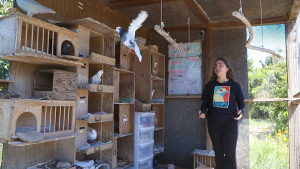
Bardouka-Large cleans the Ploughshares Nursery aviary, housing their Bay Area rescues. (Nicole Borman/ Hearst Journalism Awards Championship)
This pigeon rescue was one of the only rescues in the country when it was first founded in 2007. Now, the movement has expanded across the world.
“If somebody calls our helpline and says, ‘I’m in New South Wales, Australia, and I just found an injured pigeon,’ we can probably find someone within 100 miles of them to help,” Bardouka-Large said.
Palomacy’s oldest domesticated pigeon lived to be 29-years-old. Most wild pigeons live 4 years.
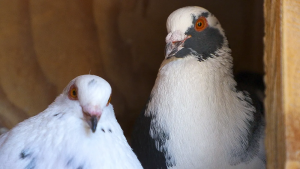
Two married pigeons wait patiently for Bardouka-Large to serve lunch, but more importantly, to find a forever home. (Nicole Borman/ Hearst Journalism Awards Championship)
Pigeons arrive at Palomacy through many different circumstances, but one of the most common is pigeon racing. In the sport, competitors bet on which bird can return home the fastest. During training, racers sometimes release groups of young pigeons and allow predators to target weaker birds, a practice known as a “basket toss.” The idea is to strengthen the genetics of the remaining flock by testing which pigeons survive.
“Some of the most harmful anthropomorphizing of pigeons is people who claim that racing pigeons are athletes,” Bardouka-Large said. “I have seen no evidence of that, I’ve seen plenty of evidence to the contrary.”
When rescued pigeons arrive at Palomacy, each bird receives individualized care. Veterinarians first evaluate them for injuries and disease before the rescue determines the next steps.
“There are some injuries that are catastrophic, and they’ll be in pain forever,” Bardouka-Large said. “We don’t want that for them, so we can’t save them.”
If the bird can recover, Palomacy provides housing, food, medical treatment and foster support tailored to each pigeon’s needs. Healthy domesticated pigeons are sometimes referred to city shelters, but many shelters still do not classify pigeons as companion animals and refuse to accept them.
“They can see their dogs, they see their cats, but they don’t really see pigeons, so people don’t see the hundreds of pigeons that need to be adopted,” Bardouka-Large said.
Back in Balestra’s apartment, the coos that greet visitors are no longer the sounds of forgotten “street birds,” but of animals that found permanence and care. For Balestra and organizations like Palomacy, rescuing pigeons is about challenging the idea that some animals are too ordinary to deserve compassion, one bird, and one home, at a time.
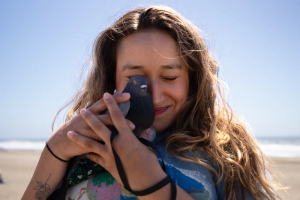
Balestra shares an emotional moment with Higgins, thanking him for being in her life and promising him she’ll always take care of him. (Nicole Borman/ Hearst Journalism Awards Championship)
